
The global accumulation of waste tires has reached a critical point, forcing municipalities, industrial operators, and environmental agencies to seek scalable, long-term solutions. Among the technologies available today, tire pyrolysis has emerged as one of the most technically mature and economically promising options. But the central question for large-scale project developers is not simply whether tire pyrolysis works — it is whether it can work reliably, consistently, and economically across high-volume tire management operations. That distinction matters enormously when making infrastructure investments that span decades.
The short answer is yes — tire pyrolysis is genuinely suitable for large-scale waste tire management projects, but only when the technology configuration, feedstock logistics, regulatory environment, and output monetization strategy are properly aligned. This article examines each of those dimensions in detail, providing decision-makers with a clear and realistic picture of how tire pyrolysis performs at industrial scale and what conditions must be met to make such projects viable and sustainable.
Understanding the Industrial Logic of Tire Pyrolysis at Scale
The Core Thermochemical Process and Its Scalability
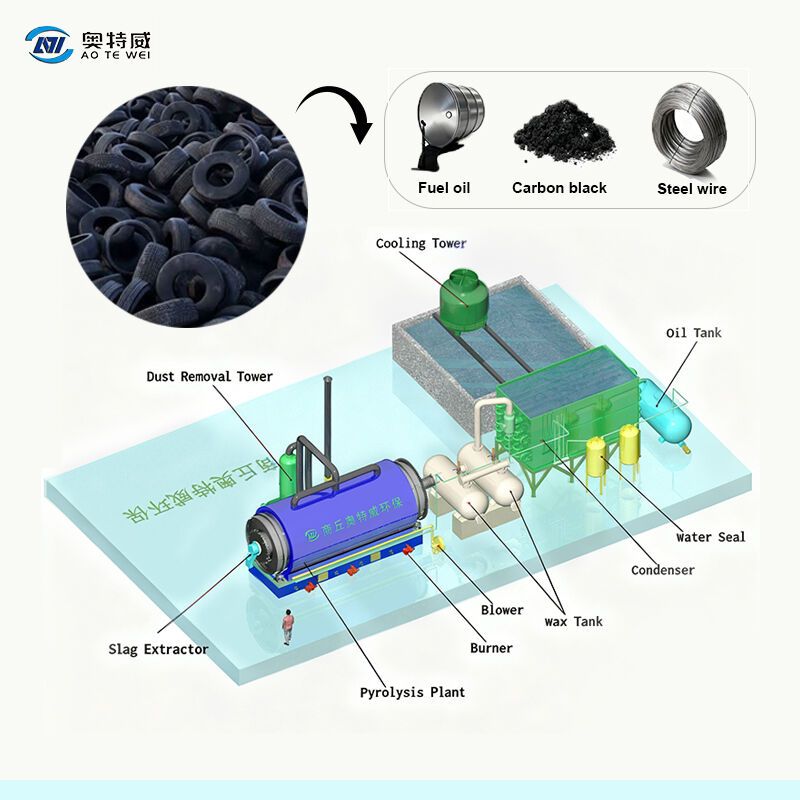
Tire pyrolysis is a thermochemical decomposition process that breaks down waste rubber under high temperatures in an oxygen-free or low-oxygen environment. When properly engineered, this process converts waste tires into pyrolysis oil, carbon black, steel wire, and combustible gas. At the batch scale, this is well understood. The more meaningful question for large-scale operations is whether the process remains stable, efficient, and controllable when operating continuously across much larger volumes.
Fully continuous tire pyrolysis systems — capable of processing 30 to 100 tonnes per day — have been developed specifically to address the limitations of small batch units. These systems maintain a constant thermal environment, reduce downtime between cycles, and allow automated feeding and discharge of materials. The engineering sophistication required is substantial, but it has been proven in industrial deployments. For large-scale waste tire management projects, the continuous operation model is not just preferred — it is essentially necessary to justify the capital investment and to match the feedstock volumes generated by major urban centers or industrial tire collection networks.
The chemistry of tire pyrolysis does not change at scale; what changes is the demand for precision engineering in temperature control, residence time management, and gas handling. When these variables are managed correctly in a well-designed continuous plant, the output ratios remain consistent and the process becomes genuinely industrial in character rather than experimental.
Capacity Requirements for Meaningful Waste Tire Volume Reduction
A large-scale waste tire management project typically involves handling tens of thousands of tonnes of tires per year. A single tire pyrolysis plant operating at 50 tonnes per day processes approximately 18,000 tonnes annually. Multiple units or higher-capacity systems can scale this further. For regional or national waste tire management programs, this capacity benchmark is not trivial — it represents a genuine infrastructure-grade solution rather than a token recycling effort.
The ability to modularize tire pyrolysis capacity is an important planning advantage. Rather than constructing a single enormous facility that carries all the operational and regulatory risk, project developers can deploy multiple continuous pyrolysis units at a single site or across distributed locations. This distributed model aligns better with tire collection logistics and reduces transportation costs, which are a significant component of total project economics. The scalability of tire pyrolysis from pilot to full industrial deployment is one of its defining advantages in large-scale planning contexts.
Economic Viability Across High-Volume Operations
Revenue Streams That Support Large Project Economics
Tire pyrolysis at industrial scale generates multiple revenue streams that together can make large-scale projects financially attractive. Pyrolysis fuel oil, the primary liquid output, has direct value as an industrial fuel or as a feedstock for further refining. Carbon black recovered from the process can be sold as a recovered carbon black product used in manufacturing, though quality upgrading may be required to achieve premium market positioning. Steel wire recovered during tire shredding and pyrolysis carries scrap metal value. And the non-condensable combustible gases generated during pyrolysis are typically recycled back into the system as process fuel, reducing external energy input requirements.
For large-scale projects, the aggregated value of these outputs across thousands of tonnes of processed material creates a meaningful revenue base. The economic model of tire pyrolysis becomes more favorable at larger scale partly because fixed costs — engineering, permitting, site infrastructure — are spread across higher output volumes, and partly because larger operations can negotiate better terms for oil and carbon black offtake. Project developers should conduct detailed output revenue modeling based on local market conditions for each product stream before committing capital.
Operational Costs and Energy Efficiency Considerations
The operational cost profile of a large-scale tire pyrolysis plant includes energy consumption, labor, maintenance, waste handling for non-recyclable residues, and regulatory compliance costs. Fully continuous systems offer a critical advantage here: they are significantly more energy-efficient than batch systems because they maintain a stable thermal state rather than repeatedly cycling through heating and cooling phases. In a well-designed continuous tire pyrolysis plant, the combustible gas recovered during the process provides a substantial share of the thermal energy needed to sustain pyrolysis temperatures, reducing dependency on external fuel sources.
Labor requirements per tonne of processed material are also lower in continuous systems due to automation of feeding, discharge, and monitoring functions. The capital cost of a high-capacity tire pyrolysis plant is higher than a batch unit, but the cost per tonne processed is lower once the plant operates at design capacity. For large-scale waste tire management projects evaluated on a lifecycle cost basis, continuous tire pyrolysis technology consistently presents a more favorable economic profile than alternatives or than small-scale approaches extrapolated to larger volumes.
Technical Prerequisites for Scaling Tire Pyrolysis Successfully
Feedstock Preparation and Shredding Integration
One of the most important technical prerequisites for large-scale tire pyrolysis is consistent and adequate feedstock preparation. Whole tires cannot be fed directly into most continuous pyrolysis reactors; they must first be shredded to a manageable particle size. For high-volume operations, this means integrating industrial-grade tire shredding equipment directly into the tire pyrolysis plant workflow. Automated shredder systems that can process entire truck tires and passenger car tires at high throughput are now available and can be synchronized with continuous pyrolysis reactor feed systems.
Shredding not only enables mechanical feeding of material into the reactor but also improves heat transfer uniformity within the pyrolysis chamber, leading to more consistent product outputs. For large-scale operations, shredder capacity must be matched to reactor throughput to avoid bottlenecks. An integrated approach — where the tire pyrolysis plant includes an automatic shredder machine as part of the complete system — eliminates the need for separate feedstock contracts and simplifies operational management significantly.
Emission Control and Environmental Compliance
Environmental compliance is a non-negotiable element of any large-scale tire pyrolysis project. The pyrolysis process generates flue gases, residual solid materials, and potential volatile organic compound emissions that must be managed within the parameters set by local environmental regulations. Modern industrial tire pyrolysis systems incorporate multi-stage gas purification, scrubbing systems, and afterburner chambers to ensure that emissions remain within acceptable limits.
For large-scale projects, environmental impact assessments are typically required during the permitting phase, and ongoing monitoring of stack emissions is a standard operational requirement. The good news is that well-engineered continuous tire pyrolysis systems are designed with these requirements in mind and can meet stringent environmental standards when properly operated and maintained. Projects that invest in robust emission control infrastructure from the outset tend to avoid the costly retrofitting and operational shutdowns that can undermine project economics at a later stage.
Regulatory and Strategic Factors in Large-Scale Deployment
Regulatory Frameworks That Enable or Constrain Tire Pyrolysis Projects
The regulatory environment has a significant influence on whether tire pyrolysis is suitable for large-scale deployment in any specific jurisdiction. In many regions, waste tire pyrolysis is explicitly recognized as a legitimate and preferred end-of-life treatment option, which simplifies permitting and may qualify projects for environmental incentives or extended producer responsibility scheme support. In other jurisdictions, the regulatory classification of pyrolysis outputs — particularly whether recovered pyrolysis oil is classified as a waste or as a recovered fuel — can affect how and whether the product can be sold or used commercially.
Project developers planning large-scale tire pyrolysis operations must engage regulatory authorities early in the project development process to clarify the applicable framework for both the process and its outputs. In markets where regulatory clarity exists, tire pyrolysis projects can move efficiently from concept through permitting to commissioning. In markets where the regulatory situation is less defined, early engagement with authorities to shape or clarify the applicable rules is essential to project success.
Strategic Alignment with National or Regional Waste Management Policy
Large-scale tire pyrolysis projects are most likely to succeed when they are strategically aligned with national or regional waste management policy objectives. Many governments have set targets for reducing landfill disposal of waste tires, increasing tire recycling rates, or developing circular economy infrastructure for rubber materials. Tire pyrolysis directly addresses these policy priorities by converting a problematic waste stream into usable products and keeping the material in productive use rather than directing it to landfill or open burning — which remains a significant problem in parts of the world.
Projects that can demonstrate alignment with these policy goals are often better positioned to access government support, long-term waste supply agreements, or favorable regulatory treatment. For large-scale developers, framing tire pyrolysis as an infrastructure investment that serves public policy objectives — rather than purely as a commercial venture — can strengthen project approval processes and community acceptance. The strategic dimension of these projects is as important as the technical and economic dimensions when it comes to long-term sustainability.
Comparing Tire Pyrolysis with Alternative Large-Scale Tire Management Approaches
Material Recovery and Value Generation
Tire pyrolysis differs fundamentally from mechanical recycling approaches such as crumb rubber production or tire-derived aggregate in that it recovers energy value in the form of oil and gas rather than mechanical material value in the form of rubber particles. This distinction matters at large scale because the market for crumb rubber, while real, is constrained by application demand in sectors like sports surfaces and modified asphalt. Pyrolysis oil and recovered carbon black, by contrast, can be directed into much larger commodity markets — industrial fuel, carbon material manufacturing — with deeper demand.
For regions where crumb rubber markets are saturated or underdeveloped, tire pyrolysis provides an alternative pathway that avoids the market limitation problem. Large-scale project developers managing significant waste tire volumes need to ensure that output products can be absorbed by the market; tire pyrolysis offers more flexibility in this regard than some mechanical recycling routes. The oil output in particular has broad industrial demand that scales alongside the project's production capacity.
Infrastructure Footprint and Site Requirements
A large-scale tire pyrolysis plant requires meaningful industrial site infrastructure — land area for reactors and auxiliary systems, utilities including water and power, access roads capable of handling heavy vehicle traffic, and appropriate buffer zones for environmental and safety compliance. These requirements are comparable to other industrial processing facilities and should not be understated in project planning. However, the infrastructure footprint of a continuous tire pyrolysis plant is generally more compact per unit of waste processing capacity than some alternative approaches such as tire-derived fuel co-processing facilities or energy recovery plants.
The modular nature of tire pyrolysis systems allows project developers to phase infrastructure investment, starting with a defined initial capacity and expanding as operational experience accumulates and market conditions support higher throughput. This phased investment approach reduces the risk associated with large upfront capital commitments and allows projects to build operational expertise progressively — a significant advantage in an industry where operational performance is critically dependent on team competence and process familiarity.
FAQ
What daily processing capacity is considered suitable for a large-scale tire pyrolysis project?
For a project to be meaningfully classified as large-scale, a continuous tire pyrolysis plant should generally operate at a minimum of 30 tonnes per day, with 50 to 100 tonnes per day considered more appropriate for regional waste management programs. At these capacities, the economics improve significantly, the output volumes justify downstream product marketing infrastructure, and the environmental impact on waste tire accumulation is measurable at a regional level.
Is the oil produced from tire pyrolysis commercially usable without further processing?
Pyrolysis oil produced from tire pyrolysis can be used directly as an industrial fuel in boilers, kilns, and certain marine engines without further refining in many applications. For use as a transportation fuel or as a petrochemical feedstock, additional distillation or upgrading is typically required. Large-scale project developers often integrate basic distillation into the plant design to improve oil quality and expand the range of potential buyers, which strengthens overall project economics.
How does the integration of a tire shredder affect the efficiency of large-scale tire pyrolysis?
Integrating an automatic tire shredder into a large-scale tire pyrolysis plant significantly improves overall process efficiency by ensuring consistent feedstock particle size, enabling automated continuous feeding, and improving heat transfer uniformity within the pyrolysis reactor. Without shredding, large whole tires create feeding inconsistencies and thermal dead zones in the reactor that reduce yield quality and throughput reliability. For continuous high-capacity operations, shredder integration is considered an operational necessity rather than an optional feature.
What are the main risks that can undermine a large-scale tire pyrolysis project?
The main risks include regulatory uncertainty around product classification, feedstock supply inconsistency, insufficient market demand for pyrolysis oil or carbon black in the local region, inadequate emission control infrastructure leading to compliance failures, and underestimation of operational complexity during the startup phase. Large-scale tire pyrolysis projects that conduct thorough feasibility studies — covering all of these risk categories before committing capital — are substantially more likely to achieve stable and profitable long-term operations than those that prioritize speed to deployment over due diligence.
Table of Contents
- Understanding the Industrial Logic of Tire Pyrolysis at Scale
- Economic Viability Across High-Volume Operations
- Technical Prerequisites for Scaling Tire Pyrolysis Successfully
- Regulatory and Strategic Factors in Large-Scale Deployment
- Comparing Tire Pyrolysis with Alternative Large-Scale Tire Management Approaches
-
FAQ
- What daily processing capacity is considered suitable for a large-scale tire pyrolysis project?
- Is the oil produced from tire pyrolysis commercially usable without further processing?
- How does the integration of a tire shredder affect the efficiency of large-scale tire pyrolysis?
- What are the main risks that can undermine a large-scale tire pyrolysis project?