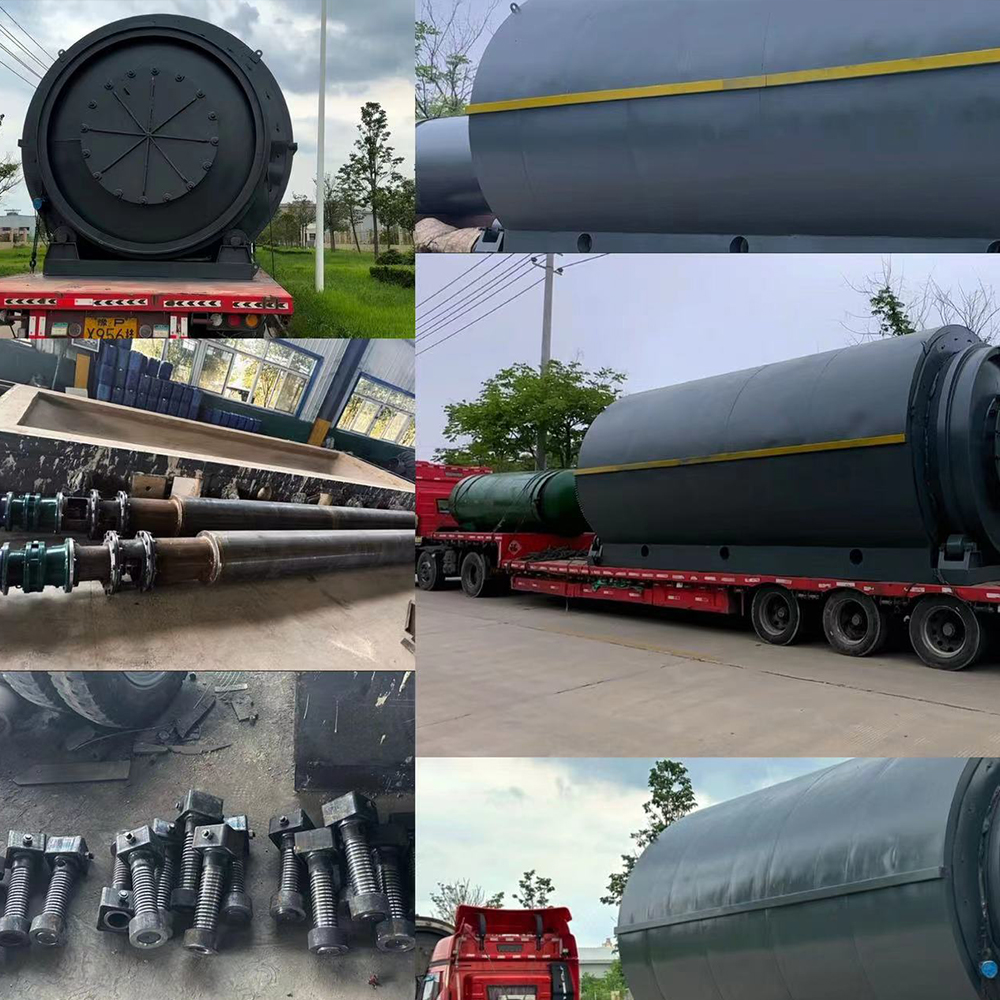
If you are evaluating waste-to-fuel projects, you will meet two technology families that are constantly confused with each other. One is the gasification → syngas → Fischer-Tropsch (F-T) → finished fuels chain. The other is the pyrolysis → pyrolysis oil → distillation / refining chain. Both can turn waste into liquid hydrocarbons, both are called "chemical recycling" in some marketing material, and both produce a diesel-like product. But they are not the same process, they do not use the same equipment, and they do not suit the same investor.
This article explains the difference in engineering terms, then looks at where distillation of pyrolysis oil, plastic oil and tyre-derived fuel actually fit.
1. Two routes at a glance
|
Gasification → Syngas → F-T → Fuels |
Pyrolysis → Pyrolysis Oil → Distillation |
Core reaction |
Partial oxidation at 700–1,400 °C with air / O₂ / steam |
Thermal decomposition at 350–550 °C in an oxygen-free reactor |
Intermediate |
Carbon monoxide + hydrogen (syngas) |
Condensable hydrocarbon vapour → pyrolysis oil |
Main conversion step |
Catalytic synthesis (Fe or Co catalyst, 200–350 °C, 2–5 MPa) |
Condensing, then oil distillation / hydrotreating |
Products |
Synthetic crude, waxes, diesel, naphtha |
Pyrolysis oil, heavy pyrolysis oil, recovered carbon black, steel wire, non-condensable gas |
Sulphur in raw liquid |
Essentially zero (syngas is cleaned first) |
Typically 0.3–0.5 % in tyre/plastic oil; needs desulphurisation |
Typical scale |
Hundreds of thousands of tonnes per year, very high CAPEX |
3–50 t/d modular units, low to medium CAPEX |
Best feedstock |
Homogeneous biomass, coal, MSW-derived RDF, natural gas |
Discarded tires, green tyre scrap, rubber waste, PE/PP/PS, oily sludge |
The shortest summary: gasification breaks feedstock all the way down to two molecules (CO and H₂) and builds fuel back up again; pyrolysis stops halfway and keeps the molecules that were already there. Everything downstream follows from that single difference.
2. The gasification / Fischer-Tropsch route: rebuild the molecule
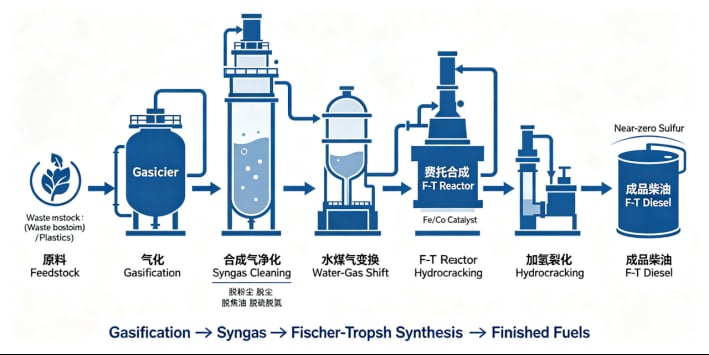
In gasification, the feedstock reacts with a controlled amount of oxygen and steam. Long polymer chains and carbonaceous solids are converted into a raw gas containing CO, H₂, CO₂, methane, tars, particulates, sulphur and nitrogen compounds. Before any synthesis can happen, the gas must be cleaned — the purification of syngas is a plant within the plant. Particulates poison catalysts, tars block pipes, and ammonia / H₂S must be removed. The H₂:CO ratio is then adjusted by water-gas shift.
Clean syngas enters the F-T reactor, where iron- or cobalt-based catalysts assemble hydrocarbon chains. Product distribution follows the Anderson–Schulz–Flory law, so a single reactor cannot produce only diesel: it produces a broad slate from light gases to hard waxes. The waxes are then hydrocracked and isomerised in a petroleum refining industry style upgrading train. Shell's SMDS process is the classic reference: a tubular fixed-bed reactor with a cobalt catalyst, commercialised in Bintulu, Malaysia and later scaled up in Qatar.
The great advantage is product quality. Because sulphur and nitrogen are removed at the gas stage, F-T diesel is almost sulphur-free and easily meets the strictest fuel standards — the reason the route is often discussed alongside fossil fuel refining process and the process of refining petroleum. The disadvantages are equally clear: gasification plus gas cleaning plus F-T synthesis plus hydrocracking is a long chain with high capital intensity, demanding feedstock preparation and a large minimum economic scale. It is a refinery, not a recycling line.
3. The pyrolysis route: keep the molecules you already have
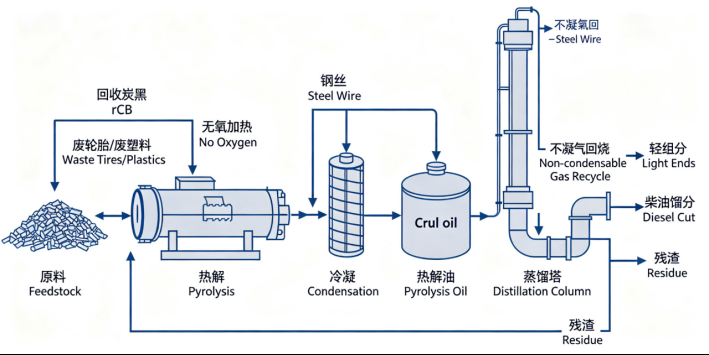
Pyrolysis recycling process chemistry is much shorter. Inside a batch pyrolysis reactor, a plastic pyrolysis reactor or a continuous rotary kiln, oxygen is excluded and heat breaks polymer chains into shorter fragments. Those fragments leave the reactor as vapour and are condensed into plastic oil / tyre pyrolysis oil. The solid residue is recovered carbon black (rCB) plus steel wire, and the non-condensable fraction — often called sync gas — is recycled to fire the burner. That is the whole plastic into fuel story: one thermal step plus condensation.
This is why the route dominates advanced tire recycling, environmental rubber recycling and waste plastic upcycling. A waste tire pyrolysis machine or a pyrolysis plant for waste plastic can be installed next to the waste source, at capacities from a pilot line to tens of tonnes per day. Rubber can be recycled, reusing tires and reusing old tyres become an on-site industrial operation rather than a logistics chain; car tyre disposal, car tire disposal, automobile tire disposal, old tire disposal and waste tire disposal all converge on the same feedstock preparation line.
Feedstock breadth is another differentiator. Polyethylene pyrolysis handles PE; pp plastic recycling, hard plastic recycling, abs plastic recycling, polystyrene foam recycling and thermoplastic recycling streams can all be converted to oil rather than mechanically re-pelletised. Plastic chemical recycling, chemical recycling of plastics and industrial plastic recycling are the umbrella terms buyers use. For mixed or contaminated material — waste management plastic recycling, disposal of plastic waste, plastic reuse, reclaim plastics, reuse of materials, plastic scrap recycling — pyrolysis is often the only route that still produces a saleable product. An oily sludge treatment system extends the same logic to refinery sludges.
Typical products of pyrolysis of plastics and plastic pyrolysis products are 40–45 % oil from whole tyres, up to ~70 % from HDPE and ~80 % from clean mixed plastic, with the balance split between carbon black, steel and gas. The oil itself is a mid-distillate feedstock, not a finished transport fuel: heavy pyrolysis oil and plastic pyrolysis fuel are industrial burner fuels until they are upgraded.
4. Where distillation enters the picture — and why people confuse the two routes
Here is the source of most of the confusion. Search results for distillation of pyrolysis oil, pyrolysis oil refining process, small scale pyrolysis oil refinery, waste to diesel conversion plant and plastic oil conversion machine often show flow diagrams that look like small refineries. That does not make pyrolysis a Fischer-Tropsch plant. It simply means the oil is being finished downstream.
A distillation column plant separates the raw condensate by boiling range. In a conventional refinery, crude petroleum distillation, atmospheric distillation of crude oil, crude oil atmospheric distillation, atmospheric crude distillation, atmospheric and vacuum distillation of crude oil, distillation process of petroleum crude oil and distillation in petroleum refining are the first units after the desalter. A pyrolysis-oil line borrows exactly the same unit operations, at a smaller scale:
• Oil distillation / fuel oil distillation process / steam distillation plant → cut light ends, distillation diesel and residue.
• Diesel distillation / refine diesel / distillation of kerosene → produce a diesel-range cut and a kerosene-range cut.
• Multi column distillation plant / continuous distillation system → tighter cuts and steady-state operation.
• Heavy oil purification machine, oil regeneration equipment, refining used oil → clean-up of the heavier fractions.
• Distillation in refinery, oil refinery distillation process, distillation process in refinery, distillation factory, distillation column plant → the equipment vocabulary buyers actually search for.
The same downstream train serves adjacent feedstocks: used motor oil, used engine oil, old motor oil uses, reconditioned oil, recycled base oil, engine oil waste, hydraulic oil disposal, hydraulic oil recycling, mineral oil disposal, heating oil disposal, car oil recycling, recycle old motor oil, old oil disposal, best way to dispose oil, used oil collection, oil recycling and disposal, waste management oil disposal, waste oil disposal services, waste engine oil disposal, motor oil waste disposal and commercial oil recycling all end up in an oil recycling plant, engine oil recycling plant, oil regeneration equipment or waste oil recycling equipment. A small scale crude oil refinery, modular crude oil refineries, crude oil distillation plant, crude oil processing plant, crude oil refinery plant cost and extraction of crude oil process describe the larger, conventional cousin of the same hardware.
So the accurate comparison is:
F-T makes a synthetic hydrocarbon, then refines it. Pyrolysis makes a real hydrocarbon mixture, then distils it. Atmospheric and vacuum distillation of crude oil and distillation of pyrolysis oil are the same separation physics applied to two different feedstocks — not evidence of the same upstream reaction.
5. Economics, feedstock and project fit
Buyers comparing the two routes usually ask about waste tyre price, green tyre scrap, tires to green recycling, scrap tire disposal, scrap tire recycling equipment, rubber tyre disposal, used tyre disposal, tyre disposal, tyre waste disposal, tire disposal and recycling, disposal tire recycling, tire disposal & recycling, tyre recycling solution, tire recycling solution, tyre recycling business, recycling tires for money, recycling of rubber waste, waste rubber recycling, truck tyre recycling, tyre & rubber recycling, tyre and rubber recycling, car tire recycling, car tyre disposal, waste tire disposal and used tyre recycling. These are all feedstock-supply questions — and feedstock supply is where the pyrolysis route wins, because a tyre disposal and recycling project can start at a few tonnes per day with negative-cost or low-cost feed.
On the product side, the questions become plastic oil, products of plastic pyrolysis, products of pyrolysis of plastics, plastic pyrolysis fuel, making oil from plastic, plastic to oil machine for sale, plastic into fuel, plastic scrap recycling, plastic recycling facility, plastic recycling companies, plastic recycling factory, plastic recycling manufacturer, plastic recycling companies, mechanical recycling of plastic, pe recycling, pp plastic recycling, thermoplastic recycling, reusing tires, recycling tires for money and pyrolysis plant manufacturer. A waste plastic pyrolysis plant, waste plastic pyrolysis machine, plastic pyrolysis plant, pyrolysis plant for waste plastic, waste rubber pyrolysis plant, waste rubber recycling, waste rubber pyrolysis plant, rubber pyrolysis, rubber pyrolysis machine, batch pyrolysis reactor, plastic pyrolysis reactor, waste tire pyrolysis machine, tyre pyrolysis plant, tyre pyrolysis machine, small scale tyre recycling plant or scrap tire recycling equipment is a purchasing decision; a gasification + F-T complex is a national-scale infrastructure decision.
Rule of thumb: if your project is measured in tonnes per day, has a mixed or dirty feedstock, and needs a modular, relocatable, quickly permitted asset, you are on the pyrolysis → distillation of pyrolysis oil road. If it is measured in hundreds of thousands of tonnes per year with a homogeneous, contractually secured feedstock and a multi-hundred-million-dollar budget, the gasification → F-T road becomes plausible.
6. A note on product quality and compliance
Raw plastic oil / tyre pyrolysis oil is not road diesel. Typical indicative values from a pyrolysis line are density around 0.89–0.94 g/cm³, sulphur 0.3–0.5 %, flash point 30–40 °C and calorific value around 9,500 kcal/kg. After distillation of pyrolysis oil in a small scale pyrolysis oil refinery, a diesel cut can reach a flash point ≥ 55 °C, sulphur ≤ 0.2 % and cetane number ≥ 45 — but it still requires hydrotreating / desulphurisation before it can be sold as on-road diesel. By contrast, F-T diesel is inherently near-zero sulphur because the cleaning happens on the gas.
That distinction matters for market access. Plastic into fuel projects selling into industrial boilers, cement kilns, steel plants and marine fuel blenders face a different compliance burden than projects targeting transport fuel. It also explains why waste to diesel conversion plant, distillation diesel, refine diesel, oil regeneration equipment, recycled base oil and used oil re-refining are such competitive search terms: buyers are looking for the upgrading step, not the reactor.
7. Frequently asked questions
Is pyrolysis the same as gasification? No. Gasification uses a controlled oxidant to produce CO + H₂; pyrolysis uses heat with no oxygen to produce a condensable oil. Pyrolysis recycling process and plastic chemical recycling describe the second route.
Can pyrolysis oil be distilled like crude oil? Yes — that is exactly what distillation of pyrolysis oil, oil distillation, diesel distillation and a distillation column plant do. The cuts are similar to crude petroleum distillation, but the feed contains more olefins, sulphur and nitrogen and needs stabilisation.
Do I need a full refinery? Usually not. A small scale crude oil refinery, modular crude oil refineries or a continuous distillation system plus a desulphurisation / filtration skid is enough for a fuel-oil or industrial-diesel product. Small scale pyrolysis oil refinery and heavy oil purification machine are the phrases used for that scope.
Which wastes can be processed?Discarded tires, green tyre scrap, rubber waste, waste rubber recycling streams, HDPE / LDPE / PP / PS / ABS, plastic scrap recycling residues, oily sludge treatment system feed, used motor oil, used engine oil and waste oil disposal services streams — depending on the configured front end.
What equipment does Aotewei supply? As a pyrolysis plant manufacturer we build batch pyrolysis reactor systems, semi-continuous and fully continuous pyrolysis lines, distillation and refining skids, carbon black handling, feeding and gas-recovery systems. See our product catalogue for models and technical parameters.
8. Work with a plant builder who knows which route you are on
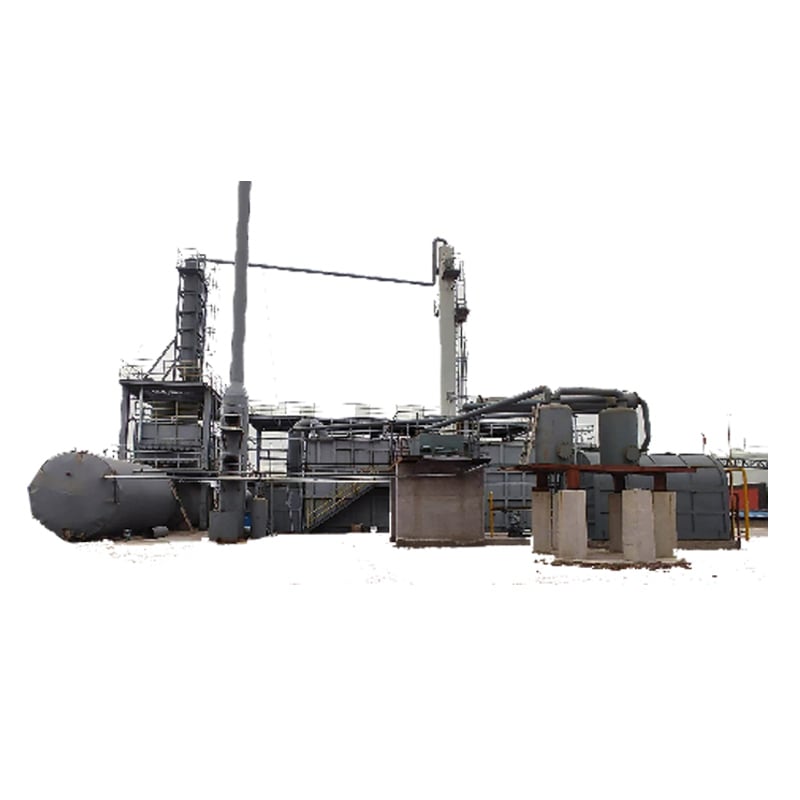
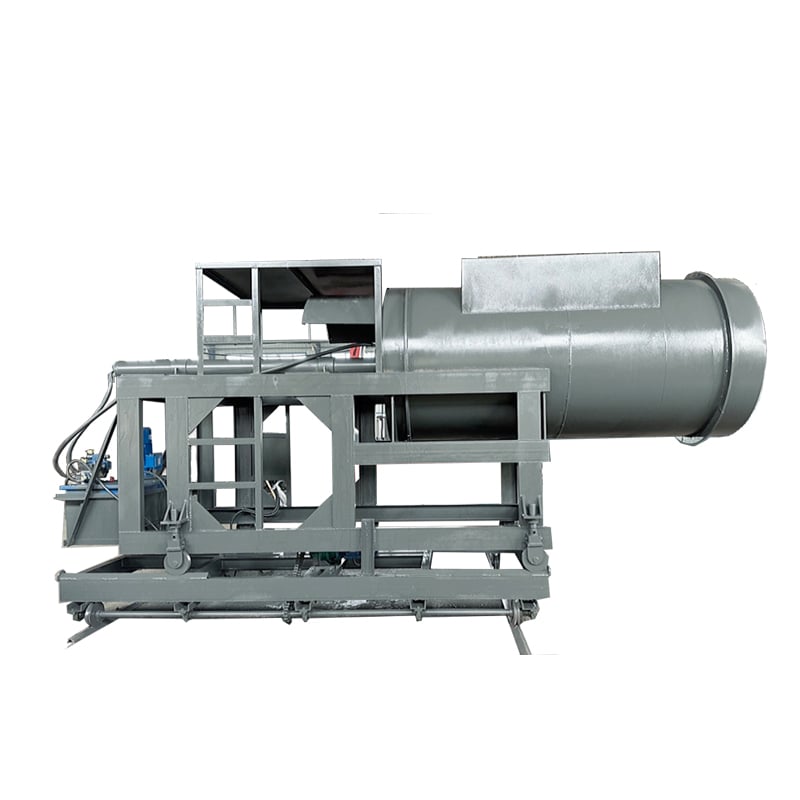
Aotewei (Shangqiu Aotewei Environmental Protection Equipment Co., Ltd.) designs and manufactures pyrolysis, distillation and refining equipment, plus the feeding, cutting, wire-drawing and carbon-black auxiliary machines that make a complete line. If your project starts with waste tyres or waste plastics rather than a billion-dollar syngas complex, we can scope the waste plastic pyrolysis plant / waste tire pyrolysis machine and the downstream pyrolysis oil distillation plant as one integrated package.
Where Aotewei Fits: The Practical Case for the Pyrolysis Route
Both routes have a legitimate place, and it is worth stating plainly where each wins. A gasification → syngas → Fischer-Tropsch complex wins on product purity at very large scale: near-zero sulphur diesel, homogeneous feedstock under long-term contract, and a budget measured in hundreds of millions of dollars. A pyrolysis → pyrolysis oil line wins on everything a mid-size recycler actually optimises for: capital outlay, time to first barrel, feedstock tolerance, modular relocation, and the ability to earn from three output streams at once — oil, recovered carbon black and steel wire.
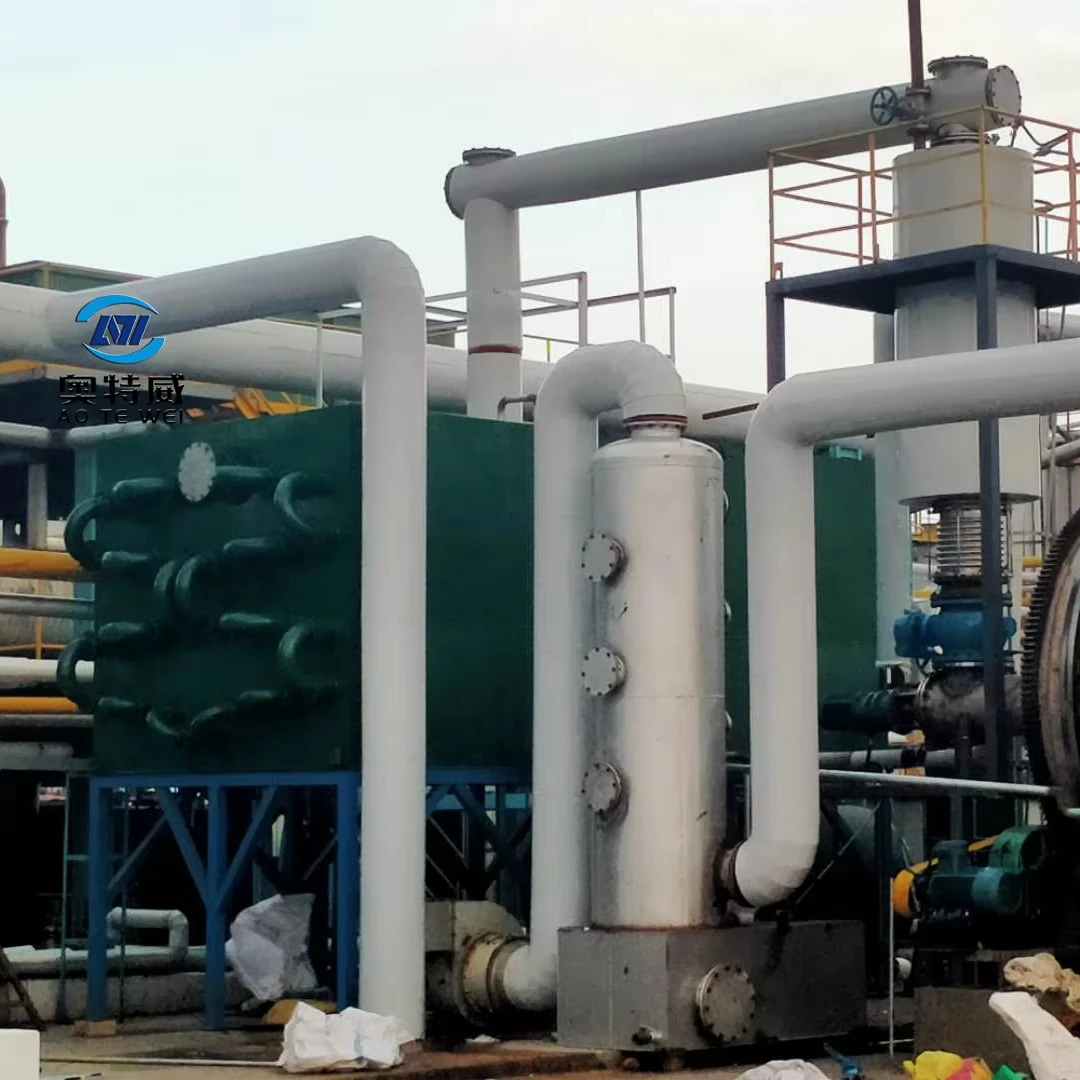
Aotewei builds that second route as a complete, staged package. The pyrolysis equipment family spans batch, semi-continuous and fully continuous operation from pilot scale to 20–50 t/d; a continuous tyre pyrolysis plant runs 24 hours under PLC control. Indicative tyre oil yield is 40–45 %, and the non-condensable gas is recycled to fire the burner, so the line is largely self-sufficient in heat. Downstream, the horizontal distillation units recover 85–95 % of the oil at just 15–25 kW installed power. In other words, a waste plastic pyrolysis plant from Aotewei is specified by output, not by reactor size.
The commercial advantage is that the plant does not have to be built all at once. Phase 1 sells raw pyrolysis oil as industrial fuel; Phase 2 adds a pyrolysis oil distillation plant for a diesel-range cut; Phase 3 adds desulphurisation and refining once the offtake contract justifies it. An F-T complex offers no equivalent staged path — the gasifier, gas-cleaning island, synthesis loop and hydrocracker must all exist before the first litre is produced. That is why a pyrolysis plant manufacturer who also supplies the distillation column plant is a lower-risk partner than a reactor-only vendor.
If your project is measured in tonnes per day rather than hundreds of thousands of tonnes per year, send us the feedstock analysis and target product. We will scope the waste tire pyrolysis machine / waste plastic pyrolysis plant and the downstream distillation of pyrolysis oil as one integrated line.
Data note: indicative oil yields, product parameters and model designations quoted above are taken from Aotewei's product catalogue. Actual values depend on feedstock composition, moisture, temperature profile and the configured upgrading train.




 Hot News